
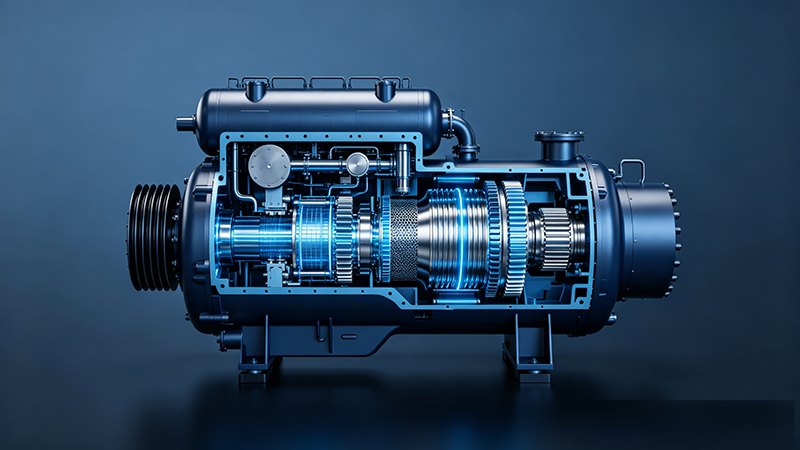
As high-end equipment upgrades toward higher speed, efficiency and reliability, the core support components determine the performance ceiling. Magnetic bearing technology — contactless, frictionless and oil-free — is the key to breaking traditional bearing limits, and is widely used in magnetic bearing compressors, high-speed centrifuges and high-end fluid machinery.
1. Working principle. Magnetic bearings levitate the rotor stably without contact through closed-loop control. High-precision displacement sensors capture rotor position at micron level; digital controllers process signals and compute commands within milliseconds; power amplifiers convert commands into controlled currents that adjust the electromagnet field and correct rotor position in real time. Unlike rolling or sliding bearings, magnetic bearings eliminate mechanical contact entirely, avoiding friction losses, wear and oil dependence by principle.
2. Core components. The system comprises four key parts working in concert: electromagnetic actuators generating multi-dimensional controllable forces for five-degree-of-freedom support; high-precision displacement sensors as the "sensing" element; high-speed digital controllers as the "brain" with dedicated algorithms; and power drive modules converting signals into stable electromagnetic drive. Together they deliver low loss, low vibration, low noise, no lubrication and long life.
3. Advantages and value. Speeds above 50,000rpm are supported; frictionless operation cuts drive energy; no oil and no wear drastically reduce maintenance; oil-free running suits high-cleanliness applications. In magnetic bearing compressors, the bearings are the key guarantee of efficient, stable, long-life operation. As localization of high-end equipment advances, continued breakthroughs in magnetic bearing technology will further improve equipment reliability and competitiveness across industrial energy saving, green manufacturing and high-end fluid machinery.